ClieNFarms Final Conference “A journey towards climate neutral farms”
The ClieNFarms Final Conference, “A journey towards climate neutral farms”, brought together researchers, farmers, policymakers, advisors and value-chain actors to reflect on four years of systemic experimentation under the Horizon Europe-funded ClieNFarms project. Held in Brussels on 20 November 2025, the event gathered 126 participants, with 85 attending in person and 41 joining online, highlighting strong interest across Europe in the future of climate-neutral farming.
Europe’s agricultural transition at a turning point
Europe’s agricultural transition is entering a decisive phase. With the newly adopted Implementing Regulation under the EU’s Carbon Removals and Carbon Farming (CRCF) framework, the European Union is taking its first steps toward a voluntary certification system that will shape how soil carbon, carbon farming measures and land-based removals are recognised.
At the same time, farmers across Europe face increasingly unstable climatic and economic conditions, while value chains, advisors and policymakers operate under differing measurement rules, incentive structures and risk constraints. These pressures expose a deeper structural challenge: the systems designed to measure, finance and incentivise agricultural climate action are not yet aligned. This misalignment directly influences what farmers can adopt, how companies invest, how advice is delivered and how progress is assessed.
Over the past four years, ClieNFarms has acted as a diagnostic tool for understanding these system interactions. Across twenty demonstration environments and more than one hundred outreach and replication farms, the project examined where climate actions succeed, where they falter and what this means for Europe’s next steps.
The conference programme was structured around four sessions, each addressing a key dimension of the transition towards climate-neutral farming.
Session 1 – Smarter agriculture for climate neutrality
The first session presented farm climate assessments, an online catalogue of climate solutions, and carbon action plans tested on demonstration farms across Europe. Farmers and advisors shared real-world experiences, showing how climate action looks on the ground and what it takes to make solutions viable across diverse farming systems.
A key conclusion was that evidence must be practical and locally relevant for farmers to engage confidently in climate action.
Session 2 – Scaling climate in farming systems
Scaling emerged as a central challenge in the second session. Discussions focused on barriers, solutions and business approaches that can connect farmers with industry and enable climate action beyond pilot projects.
Actors from different value chains illustrated how incentives, contracts, and shared responsibilities influence adoption. The session reinforced one of ClieNFarms’ key findings: climate measures are only scalable when evidence, incentives, and advisory systems move in the same direction.
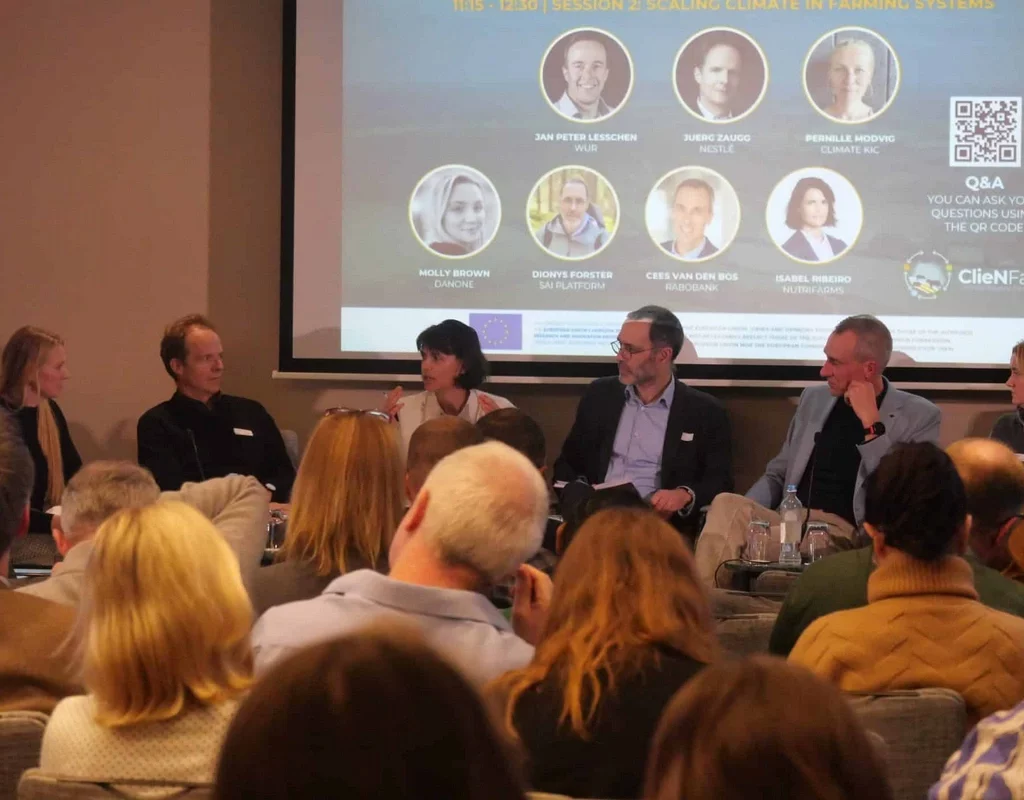
Photo: © Rafaël Thorel, INRAE.
Session 3 – Advancing knowledge for climate-smart farming
The third session highlighted how research, data and modelling support better decisions on farms. ClieNFarms’ work on monitoring and evaluation approaches, from simple farm-level tools to advanced process-based models, showed both the potential and the limits of current methods.
A recurring message was that progress depends not only on better models, but on clear guidance, consistent data and tools that farmers and advisors can trust and use.
Session 4 – Challenges in Modeling GHG emissions on European farms
The final session brought the discussion to the policymaking level. With the implementation of the CRCF approaching, participants examined GHG accounting tools, soil carbon modelling and certification challenges.
ClienNFarms’ analysis revealed that defining progress remains complex: indicators per hectare, per product and per farm often tell different stories. Without consistent frameworks, uncertainty persists for farmers, businesses and investors.
Co-creation as a catalyst for change
Across sessions, the importance of co-creation was highlighted. Through its Creative Arenas, ClieNFarms brought farmers, advisors, researchers and value-chain actors together to jointly explore solutions. As highlighted during the conference, these spaces change not only decisions, but also how actors listen to and understand each other.
Farmers consistently emphasised the need for clear guidance, tested examples, advisory support and shared risk, alongside stable and predictable policy frameworks.
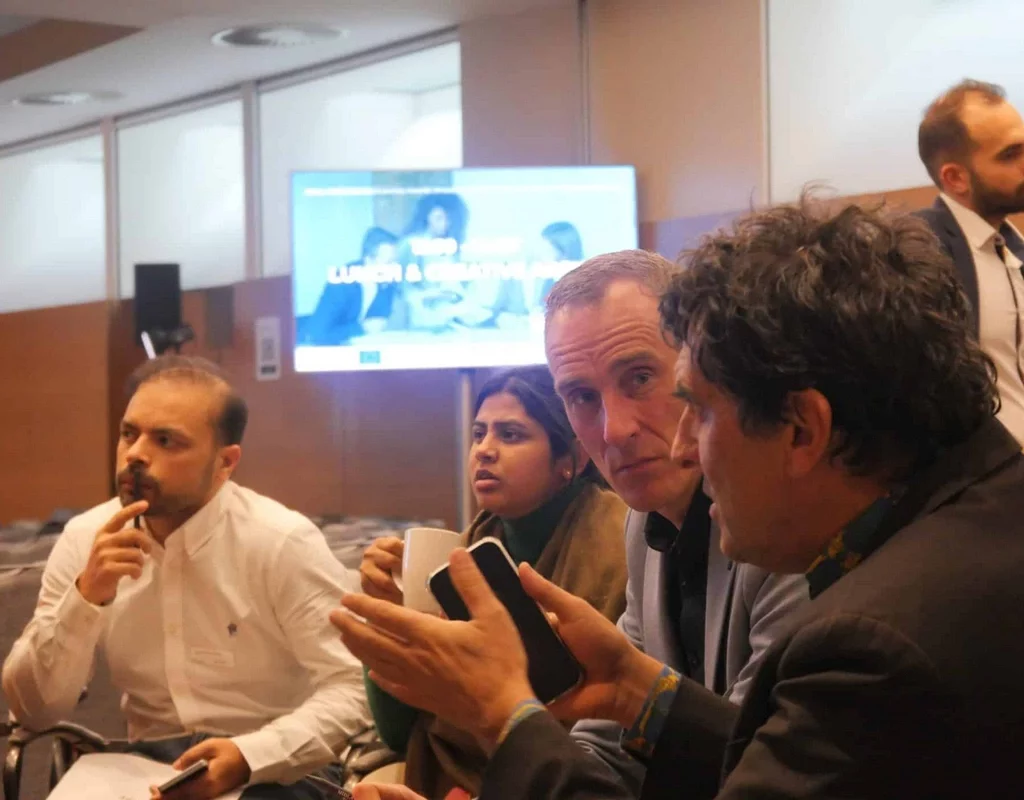
Creative Arena at the Final Conference
. Photo: © Rafaël Thorel, INRAE.
A basis for Europe’s next steps
ClieNFarms leaves behind a rich set of tools, case studies, policy insights and co-creation methods. More importantly, it offers clarity on the systemic conditions that enable — or obstruct — climate-neutral agriculture.
As Europe moves forward with CRCF implementation and carbon farming methodologies, ClieNFarms provides timely guidance on aligning evidence, incentives, advisory systems and policy signals. Climate-neutral farming will require both innovation and trust. The project has helped show how these elements can come together — and what Europe must address next to turn ambition into farmer-centred action.
The full recording of the conference is available online, allowing a wider audience to participate in the discussions and key messages. You can watch the full video here: https://www.youtube.com/watch?v=3ob-v-_N22o&t=3200s.
Based on an article by Climate KIC.